The modern traveler, especially the burgeoning digital nomad and remote worker, faces a constant battle for space and power. Every ounce counts, and a dead battery can mean a lost connection, a missed deadline, or a moment of digital isolation. At the heart of this struggle lies the humble yet critical power adapter. For years, the bulky silicon brick charger has been a familiar, albeit cumbersome, travel companion. However, a new contender has emerged, promising a revolution in size and efficiency: the Gallium Nitride (GaN) charger. This article dives deep into the head-to-head comparison between GaN and traditional silicon chargers, dissecting their strengths, weaknesses, and suitability for the demands of compact, efficient travel in 2026.
The Compact Charger Showdown: GAN vs. Silicon Brick
The quest for smaller, more powerful charging solutions has led us to a pivotal point in consumer electronics. The need for devices that can simultaneously charge a laptop, a tablet, and a smartphone without hogging an entire power strip or suitcase compartment is paramount. This has fueled the rapid development and adoption of GaN technology, challenging the long-reigning dominance of silicon-based chargers. Understanding the fundamental differences between these two technologies is key to making an informed decision for your portable power needs.
Understanding GAN Technology: The Future of Charging
Gallium Nitride (GaN) is a semiconductor material that has been lauded for its ability to handle higher voltages and temperatures than traditional silicon. This superior performance translates directly into more efficient and smaller power adapters. GaN components can switch on and off much faster and with less energy loss, meaning less heat is generated. This reduction in heat allows engineers to pack more power into a smaller physical footprint and eliminate the need for bulky heat sinks. Essentially, GaN enables chargers to be significantly smaller, lighter, and more powerful than their silicon predecessors. This is particularly impactful for USB-C PD (Power Delivery) chargers, which are designed to offer high wattage outputs for everything from smartphones to laptops.

The Traditional Silicon Brick: A Familiar Workhorse
For decades, silicon has been the backbone of the electronics industry, including power adapters. Silicon chargers, often referred to as “brick” chargers due to their shape and size, work by using silicon-based transistors to convert AC power from the wall outlet to the DC power required by our devices. While reliable and well-understood, silicon technology has inherent limitations. To handle higher power outputs, silicon chargers require larger components and more robust heat dissipation mechanisms, such as larger casings and heatsinks. This is why chargers for laptops and other power-hungry devices have historically been so large and heavy. Despite their bulk, silicon chargers remain a viable option, especially for users who prioritize lower upfront cost or don’t have stringent space constraints.
Key Differentiators for the Modern Traveler
When packing for a trip, especially for extended remote work or international travel, the specifications of your charging gear can make or break your packing efficiency and daily convenience. The differences between GaN and silicon chargers become particularly pronounced when evaluated against the core needs of a traveler.
Compactness & Portability: Who Wins for Travel?
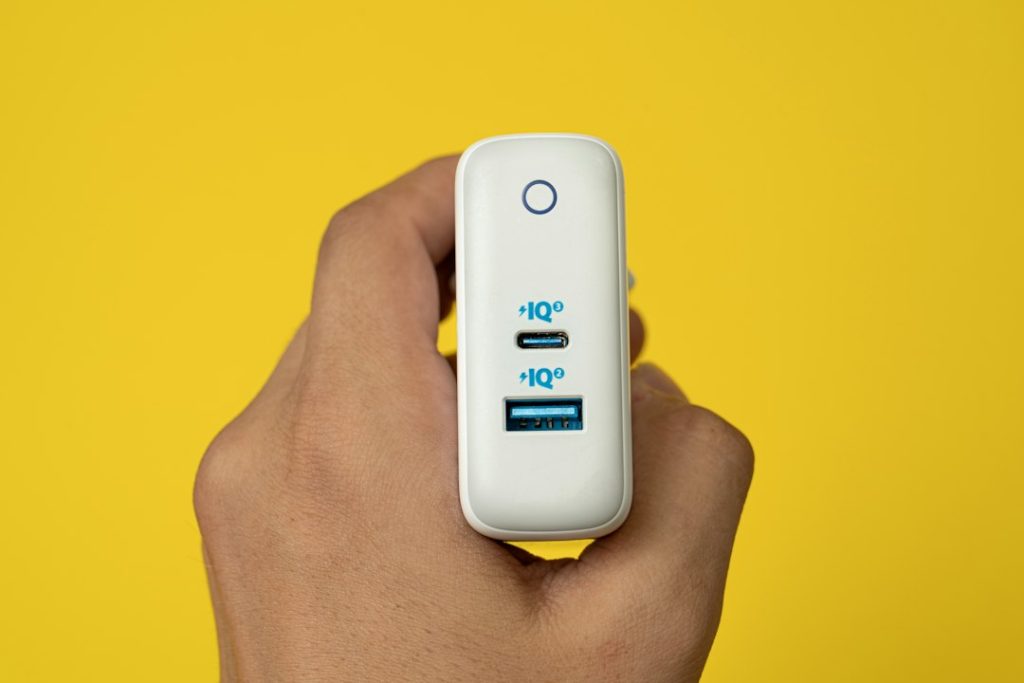
This is where GaN technology truly shines. The ability of GaN semiconductors to operate more efficiently and with less heat generation allows for dramatically smaller chargers. A 65W GaN charger, capable of powering a modern ultrabook, can be as small as a standard 20W iPhone charger. This is a stark contrast to a 65W silicon charger, which would typically be significantly larger and heavier. For the traveler, this translates to more space in a backpack or carry-on, less weight to haul, and the ability to consolidate multiple chargers into one compact unit. The difference is not just marginal; it’s often a 50-75% reduction in size and weight. GaN chargers are the undisputed champions in this category for anyone prioritizing minimalist packing.
Heat Dissipation: Performance Under Pressure
Heat is the enemy of electronics, reducing efficiency and longevity. GaN chargers inherently produce less heat than their silicon counterparts due to their superior efficiency. This means they run cooler, even when delivering maximum power. While silicon chargers can become quite hot to the touch under heavy load, GaN chargers maintain a more moderate temperature. This cooler operation not only contributes to the longevity of the charger itself but also means they can be designed with smaller, less intrusive heat sinks, further contributing to their compact size. For travelers using chargers in cramped spaces like airplane seats or hotel desks, cooler operation is a significant advantage.
Charging Speed & Efficiency: Powering Up Faster
Both GaN and silicon chargers can offer high charging speeds, especially when utilizing USB Power Delivery (USB-PD) and Quick Charge (QC) protocols. However, GaN chargers often have an edge due to their efficiency. The reduced energy loss means more of the power drawn from the wall is delivered to your device. This can translate to marginally faster charging times, especially when charging multiple devices simultaneously. Furthermore, the compact size of GaN chargers means users are more likely to carry them, ensuring they always have a fast charging solution readily available, rather than leaving a larger silicon charger behind due to inconvenience.
Durability & Build Quality: Long-Term Reliability
When comparing durability, the choice often comes down to the specific brand and model rather than solely the underlying technology. High-quality silicon chargers from reputable brands are generally very robust. Similarly, premium GaN chargers are built to last, often featuring high-grade plastics, reinforced connectors, and sophisticated internal designs. GaN’s inherent ability to run cooler can contribute to long-term reliability by reducing thermal stress on components. However, the smaller size of GaN chargers can sometimes make them feel more delicate, though this is usually a perception rather than a reflection of actual build quality. Both technologies, when implemented by reputable manufacturers, can offer excellent long-term reliability. It is crucial to look at user reviews and brand reputation for both types of chargers.
Real-World Performance: GAN Chargers in Action
The theoretical advantages of GaN translate into tangible benefits for users. The ability to carry a single, compact charger that can power a laptop, tablet, and phone is a significant quality-of-life improvement for frequent travelers and remote workers. The sheer reduction in bulk is often the primary motivator, but the cooler operation and consistent high-speed charging further solidify GaN’s appeal.
Top Compact GAN Chargers for 2026
The market for GaN chargers has exploded, offering a variety of options that cater to different needs and budgets. Here are some of the leading contenders that exemplify the benefits of GaN technology for travelers:
Ports3 (2 USB-C, 1 USB-A)
Max Output65W
Weight~1.5 oz / 43g
Dimensions~1.5 x 1.1 x 2.2 in / 38 x 28 x 56 mm
Price Range$45 – $60
Anker 735 Nano II (3-Port 65W)
👍 Pros
- Extremely compact for its power output.
- Versatile port configuration (2x USB-C, 1x USB-A).
- Reliable Anker performance and safety features.
- Charges multiple devices simultaneously.
👎 Cons
- Can get warm under sustained full load, though not excessively.
- USB-A port max output is limited when other ports are in use.
Ports2 (2 USB-C)
Max Output45W
Weight~1.4 oz / 40g
Dimensions~1.3 x 1.1 x 2.0 in / 33 x 28 x 51 mm
Price Range$25 – $35
UGREEN Nexode Mini 45W
👍 Pros
- Incredibly small and lightweight.
- Excellent value for money.
- Sufficient power for most smartphones and smaller laptops/tablets.
- Dual USB-C ports offer flexibility.
👎 Cons
- Not enough power for demanding laptops when charging two devices.
- Build quality, while good, might feel slightly less premium than Anker or Belkin.
Ports4 (3 USB-C, 1 USB-A)
Max Output65W
Weight~3.1 oz / 88g
Dimensions~2.5 x 2.0 x 1.2 in / 64 x 51 x 30 mm
Price Range$60 – $80
Belkin BoostCharge Pro 4-Port GaN Wall Charger 65W
👍 Pros
- Four ports (3x USB-C, 1x USB-A) provide maximum versatility.
- Robust build quality from a trusted brand.
- Consolidates multiple chargers into one unit effectively.
- Supports intelligent power sharing across ports.
👎 Cons
- Noticeably larger and heavier than other compact GaN options, due to the 4-port design.
- Higher price point.
Standard Silicon Brick Chargers: Still Relevant?
Despite the impressive advancements in GaN technology, traditional silicon brick chargers haven’t disappeared, and for good reason. They remain a cost-effective and reliable power solution for many scenarios. Their larger size, while inconvenient for travel, often allows for more robust cooling and potentially lower manufacturing costs, leading to cheaper retail prices.
When a Silicon Brick Might Be Your Best Bet
Silicon chargers excel in situations where portability is not the primary concern. For home or office use, where a dedicated charging spot is available, the bulkiness of a silicon brick is less of an issue. They are also often the default chargers included with laptops and other devices, meaning many users already possess them. Furthermore, for users on a very tight budget, a standard silicon charger can offer significant wattage at a lower price point than an equivalent GaN charger. If you only need to charge one device at a time and prioritize cost savings over size, a silicon brick might still be your go-to choice.
Examining Popular Standard Travel Chargers
While less compact, many standard silicon chargers are still designed with travel in mind, often featuring foldable prongs and durable casings. However, their inherent size limitations mean they can never match the space-saving efficiency of GaN.
| Feature | Example Compact GAN Charger (e.g., Anker 735 Nano II 65W) | Example Standard Silicon Charger (e.g., Basic 65W Laptop Brick) |
|---|---|---|
| Technology | Gallium Nitride (GaN) | Silicon |
| Size | Very Compact (e.g., ~1.5 x 1.1 x 2.2 in) | Significantly Larger (e.g., ~4.5 x 2.0 x 1.0 in) |
| Weight | Lightweight (e.g., ~1.5 oz / 43g) | Heavier (e.g., ~7 oz / 200g) |
| Heat Dissipation | Excellent, runs cooler | Adequate, can get very hot under load |
| Efficiency | Higher, less energy loss | Lower, more energy loss |
| Portability for Travel | Ideal, space-saving | Cumbersome, takes up significant space |
| Typical Price Range (65W+) | $40 – $80+ | $20 – $50 |
Making the Right Choice for Your Remote Work Lifestyle
Deciding between a GaN and a silicon charger boils down to prioritizing your specific needs as a traveler and remote worker. Consider these factors:
Power Needs Assessment: How Much Juice Do You Really Need?
First, determine the wattage required for your devices. Smartphones typically need 15-30W, tablets 30-45W, and modern ultrabooks or larger laptops can range from 45W up to 100W or more. If you primarily charge a phone and a tablet, a smaller 30W or 45W GaN charger might suffice. For a laptop user, especially one needing to charge multiple devices, a 65W or 100W GaN charger is essential. If your needs are modest, a cheaper silicon charger might still fit the bill, but the size savings with GaN often justify the cost even for lower wattages.
Prioritizing Portability vs. Port Count
The biggest advantage of GaN is portability. If you frequently move between locations, travel internationally, or simply hate carrying bulky gear, GaN is the clear winner. However, if you need to charge many devices simultaneously (e.g., laptop, phone, earbuds, smartwatch), you might need a GaN charger with multiple ports. These multi-port GaN chargers, like the Belkin BoostCharge Pro, can be larger than single-port GaN options, though still generally smaller than a comparable silicon charger with the same port count. If portability is paramount and you only need one or two ports, a single-port GaN charger is unbeatable.
Budget Considerations: GAN vs. Silicon Price Points
GaN technology is generally more expensive to produce than traditional silicon. Consequently, GaN chargers often carry a higher price tag, especially for higher wattages and multiple ports. A basic 65W silicon charger might cost $25-$40, while a comparable 65W GaN charger could range from $45-$80. For budget-conscious travelers, the cost difference is a significant factor. However, the value proposition of GaN lies in its size, weight, and efficiency savings, which can be worth the investment for frequent travelers who value convenience and space.
Common Questions About Compact Chargers (2026)
Q1: Can a GaN charger fully replace all my existing chargers?
A: For most users, yes. A high-wattage GaN charger (65W or 100W) with multiple ports can typically charge a laptop, tablet, and smartphone simultaneously, making it a versatile all-in-one solution for travel. Always check the wattage requirements of your devices to ensure compatibility.
Q2: Are GaN chargers safe?
A: Yes, GaN chargers from reputable brands adhere to strict safety standards. The improved thermal performance of GaN can actually contribute to safer operation by reducing the risk of overheating compared to older, less efficient silicon chargers operating at their limit.
Q3: How much smaller are GaN chargers compared to silicon ones?
A: The size reduction can be dramatic. A 65W GaN charger can be up to 50-75% smaller and lighter than a traditional 65W silicon charger, often fitting comfortably in the palm of your hand or a small pocket.
Q4: Will GaN chargers work with older devices that don’t support USB-C PD?
A: Many GaN chargers include a USB-A port alongside USB-C ports, allowing them to charge older devices. For devices that only support older proprietary fast-charging standards, a GaN charger might just charge them at a standard speed via USB-A, or you might need a specific adapter or older charger.
Q5: Is the higher cost of GaN chargers justified for casual travelers?
A: If you travel infrequently and prioritize saving money, a standard silicon charger might be sufficient. However, if you value packing light, reducing clutter, and having a powerful, efficient charging solution always at hand, the investment in a GaN charger is often well worth it, even for casual travelers.
👑 Ultimate Winner: Compact Travel Power
For the modern traveler and remote worker in 2026, the GaN charger is the clear and decisive winner. Its revolutionary compactness and lighter weight directly address the most critical pain points of mobile power: space and portability. While traditional silicon brick chargers remain functional and more affordable, they simply cannot compete with the efficiency and reduced physical footprint offered by GaN technology. GaN chargers allow digital nomads, frequent flyers, and anyone who values efficient packing to consolidate their charging needs into a single, pocket-sized powerhouse. The slightly higher upfront cost is a small price to pay for the significant convenience, reduced travel bulk, and consistently efficient performance that GaN delivers. Whether you opt for a multi-port solution like the Belkin BoostCharge Pro for maximum device support or a super-compact single-port unit like the UGREEN Nexode Mini for ultimate portability, embracing GaN is the smart choice for streamlined, modern travel.